


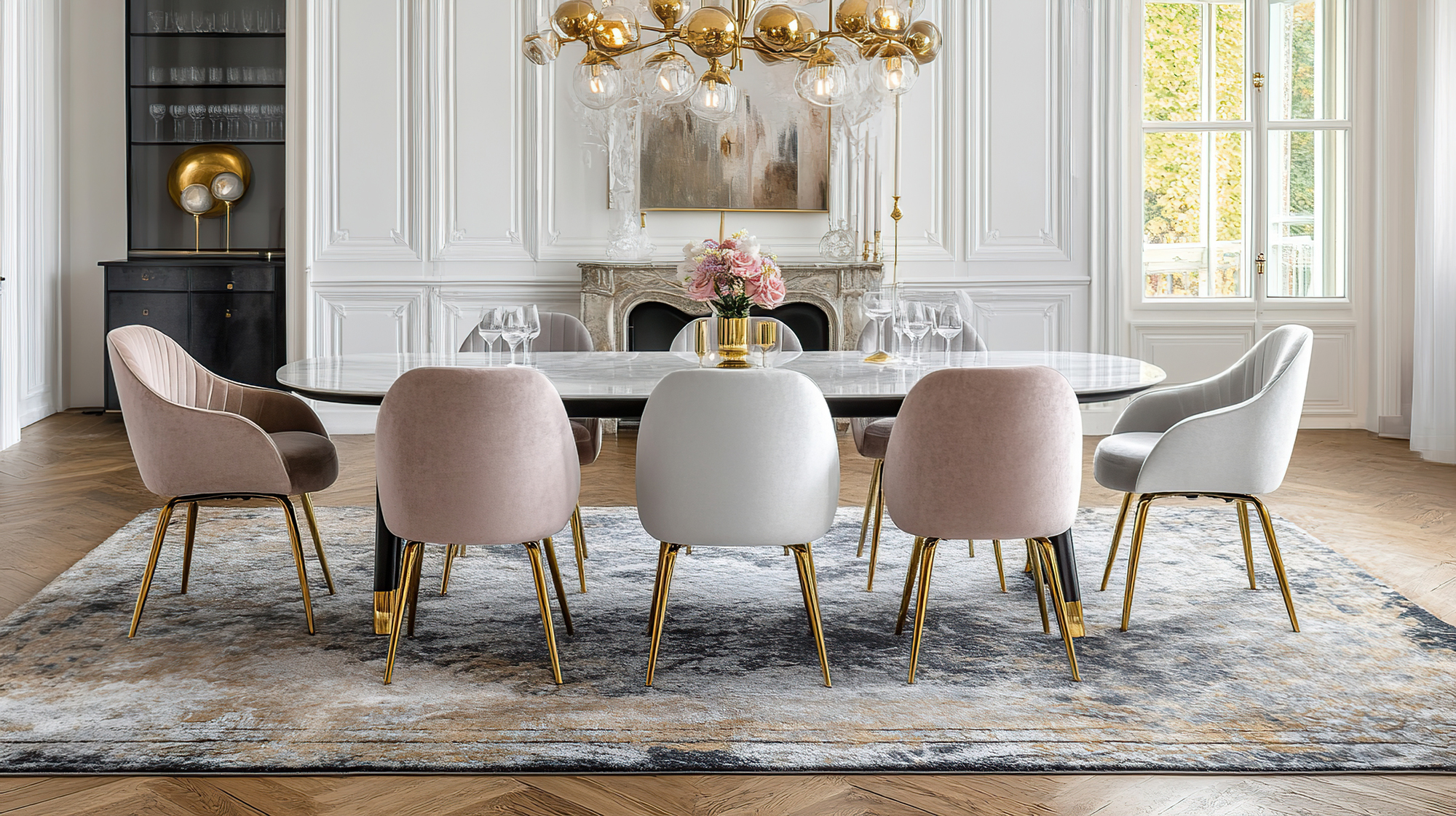
Dining Chairs Wear a Rug Differently Than Footsteps Do
Walking across a rug presses straight down, spreads the load across a whole footprint, and lifts off again. Pile handles that well because it is built to compress and recover. A dining chair does something else entirely. It concentrates weight onto four small points, and every time somebody sits down or stands up, those points drag sideways across the surface. That sideways force is what does the damage.
The useful thing about this is that the wear is completely predictable. Look at any dining rug that has been in place a few years and you will see a crescent shaped scuff behind each chair, tracing the arc where it gets pushed back and pulled in. It is not random wear spread across the rug. It is the same few square feet, several times a day, for years.
Pile Crushes Long Before It Wears Through
The failure people expect is a hole, and that is almost never what happens. What happens is permanent crushing in those arcs. The fibres get pressed flat, get dragged in one direction, and stop standing back up. Structurally the rug is completely fine. It just looks tired in a way that draws your eye straight to it every time you walk into the room.
Pile height and density change how fast this shows. A short, densely packed pile has less fibre length to fold over and more neighbouring fibres holding each one upright, so it resists the crush far better than a longer, looser pile. Shag and high pile are the hardest to keep looking right under a dining table. None of this rules pile out of a dining room, but it does mean the specification matters more here than it would in a bedroom.
Flatweaves Take the Drag Better But Move More
A flatweave has no pile to crush, so chairs glide over it rather than ploughing through it, and it wears evenly across the whole surface instead of concentrating in arcs. For a table that gets used every day, that is a genuine advantage, and it is the main reason flatweaves show up in dining rooms so often.
The trade off is weight. Flatweaves are light, and chair legs pushing sideways will walk the rug across the floor over time unless you put a grippy, low profile pad underneath. The thin profile creates a second issue at the edges, where a chair leg can catch the rug and flip it. A bound or tapered edge and a pad cut slightly smaller than the rug both help. A pile rug's own weight largely solves the shifting problem on its own, which is one point in its favour.
Your Chair Legs Matter as Much as the Rug
Before you choose a rug, turn a chair over and look at what is actually touching the floor. Castors are the hardest on pile because they roll and twist at the same time, working fibres loose rather than just flattening them. Thin metal or tapered wooden legs concentrate the whole load of a seated adult onto a very small area, which is what causes permanent crushing. Wide flat glides spread that load and cause far less trouble on either construction.
This is worth checking because it is the cheapest fix available. Swapping thin legs for wide felt or plastic glides costs very little and meaningfully changes what your rug has to cope with. If you are set on a pile rug in a busy dining room, sorting the chair legs first is a better use of money than upgrading the rug.
Size Decides Whether Any of This Works
A dining rug has one non negotiable requirement. The back legs of every chair need to stay on the rug when somebody pushes back to stand up. If they drop off the edge, you get catching, edge damage and a chair that rocks. The usual guidance is to extend the rug somewhere between 24 and 30 inches beyond the edge of the table on every side, which covers most chair depths with room to move.
Measure from the table edge outwards rather than from the centre, and do it with the leaf in if you use one. This is where a lot of dining rugs go wrong, and no amount of choosing the right construction rescues a rug that is too small. Bring your table dimensions with you and work backwards from there.
Flatweave and pile behave so differently under a dining chair that comparing them on a screen tells you almost nothing. Chicago Flooring By Manas Torcom stocks both, and our team can walk you through which one suits your chairs, your table size and how heavily the room actually gets used.
We serve Park Ridge, Chicago, Arlington Heights, Glenview, and Hinsdale, IL and welcome you at any of our Park Ridge, IL. Have a look through our area rugs to see what is available in the size you need, then contact us to arrange a visit with your table measurements in hand.

